
We work different
By making jobs more accessible, Advocations has helped more than 21,000 people with disabilities return to work
We work different
By making jobs more accessible, Advocations has helped more than 21,000 people with disabilities return to work

Individual Services
We specialize in helping disability beneficiaries return to work

Business Services
We recruit the talent you don't & make disability-inclusion your competitive advantage
Individual Services
We specialize in helping disability beneficiaries return to work
Business Services
We recruit the talent you don't & make disability-inclusion your competitive advantage
All 50 States
We support workers with disabilities & companies nationwide
121 K
People with disabilities engaged and proctively recruited since 2022
93% Retention
Our annual retention shows that job placement is just the beginning
17+ years in business
A trailblazer in disability-focused recruitment since 2009, we have consistently proven the unique role business has in driving disability-inclusive opportunities.
Job Creator of the Year
Received National recognition from the Small Business Administration (SBA) for creating 153+M in economic impact in 2017

No Cost Employment Services
Ticket To Work & Advocations
Are you tired of the limitations that come with relying solely on SSI or SSDI support? Are you ready to take control of your life and career, but feeling overwhelmed by the process?
Advocations' Ticket To Work program is here to help. Our proven system empowers SSI and SSDI recipients like you to navigate the complexities of job seeking, securing employment, and leveraging work incentives to help you achieve your short- and long-term goals.
Do you receive SSI or SSDI benefits?
Want to earn more money?
Not sure what you can do?
Worried about "messing up" your benefits?
100% disability- and woman-owned small business
100% disability- and woman-owned small business
Strategic Business Services
Make disability your competitive advantage
We have the experience you need to realize the business benefits of disability inclusion

Proactive Recruitment
Decrease turnover with our job matching service that targets qualified talent and helps them navigate your hiring process
Training & Consulting
Leverage our expertise in disability and employment to develop disability inclusive workplaces

Contingent Staffing
Low-risk, high impact strategy that provides opportunities to candidates often overlooked in traditional hiring practices

Employee Support Program
A flexible and confidential solution to manage disability-related questions and performance management
Proof that we work different
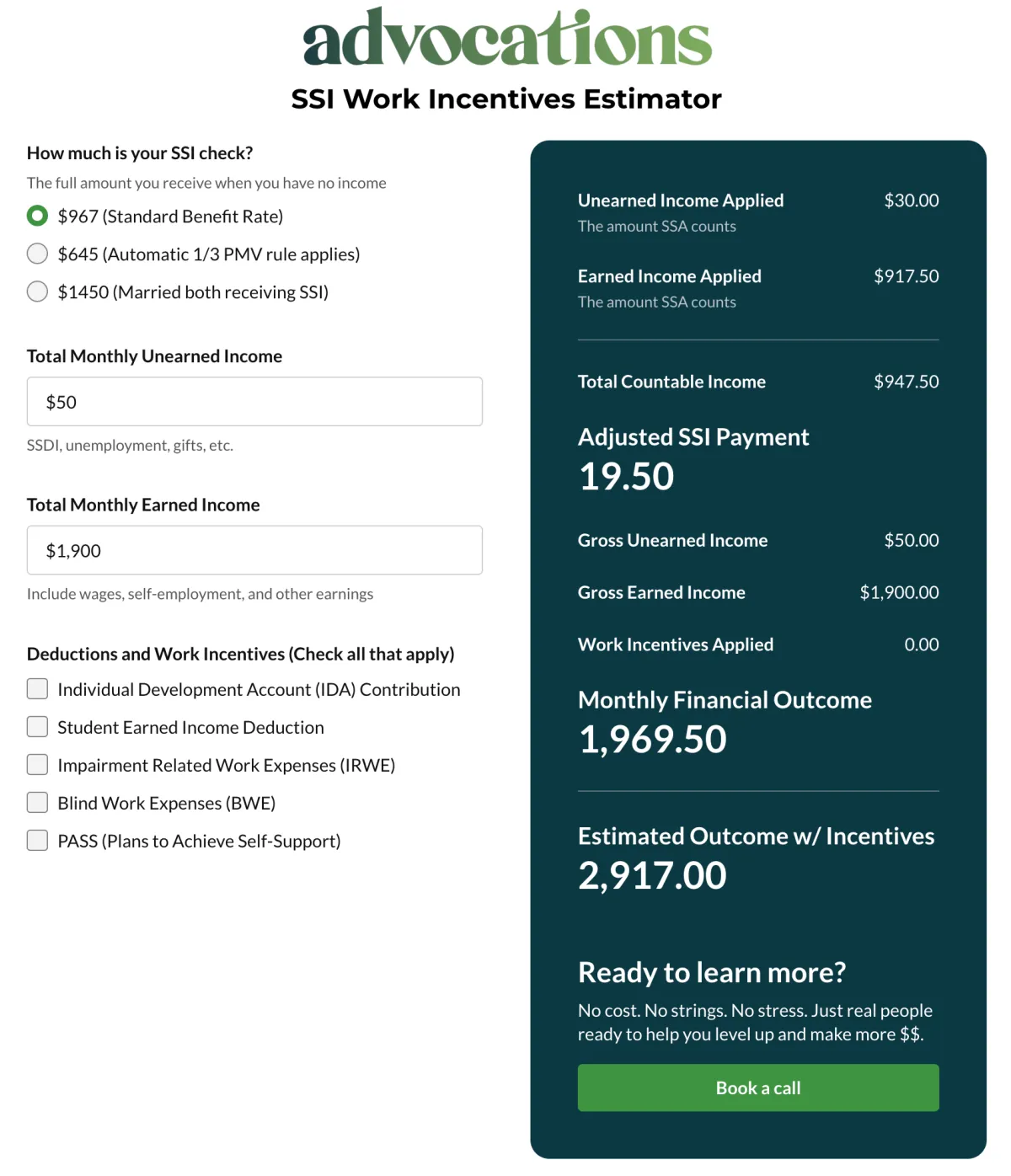
Do you receive SSI?
Check out our
SSI Work Incentives Estimator
Do you receive SSI?
Check out our SSI Work Incentives Estimator
Bipolar Disorder: Navigating the Highs and Lows at Work
Let’s be real: The standard 9-to-5 wasn't built for the ebb and flow of Bipolar Affective Disorder. Navigating a career when your energy levels fluctuate between the "highs" of mania and the "lows" of depression can feel like trying to sail a ship in a storm without a compass.
But here is what the stigma won't tell you: You are not a liability.
With the right strategy, the right environment, and the right team in your corner, your unique perspective is an asset. At Advocations, we work different. We know that managing Bipolar Disorder isn't about "fixing" yourself to fit a rigid mold—it's about building a framework where you can perform at your best, safely and sustainably.
The Reality Check: It’s Not Just "Mood Swings"
If you are living with Bipolar Disorder, you know it’s more than just having a "bad day." It’s a biological reality that impacts your energy, sleep, and focus.
The Highs (Mania/Hypomania): You might feel unstoppable, creative, and energetic. But this can also look like racing thoughts, distractibility, or taking on more work than one human can handle.
The Lows (Depression): The fog rolls in. Motivation drops, fatigue hits hard, and simple tasks can feel like climbing Everest.
The Fear-Buster Truth: These fluctuations don't disqualify you from a successful career. They just mean you need a game plan that accounts for your energy, rather than fighting against it.
Strategic Tools: Accommodations Are Your Safety Net
Under the Americans with Disabilities Act (ADA), you have a legal right to "reasonable accommodations." Think of these not as "special treatment," but as the tools you need to do your job—just like a carpenter needs a hammer.
Here are the most effective, high-impact strategies for navigating work with Bipolar Disorder:
1. Flexible Scheduling (The Sleep Saver) Sleep disruption is often the #1 trigger for episodes.
The Fix: Ask for a flexible start time (e.g., a window between 8 AM and 10 AM) to accommodate medication side effects or insomnia.
2. Environmental Control (The Focus Booster) Open-plan offices can be a nightmare for overstimulation during hypomania or irritability during depression.
The Fix: Request noise-canceling headphones, access to a private "quiet room" for breaks, or the option to telework (work from home) when symptoms flare up.
3. Written Workflows (The Memory Aid) Racing thoughts can make verbal instructions disappear instantly.
The Fix: Ask for all assignments and feedback in writing. This creates a concrete reference point so you don't have to rely solely on memory during high-stress moments.
4. The "Energy-Match" Strategy
The Fix: Structure your day around your energy. Use high-energy periods for brainstorming and creative problem solving. Save low-energy periods for routine admin tasks.
"Do I Have to Tell My Boss?" (Navigating Disclosure)
This is the big question. The "A-Team" answer? Only if you want to (or need to).
You are not required to disclose your medical diagnosis during an interview or even after you are hired. You only need to disclose if you are requesting an accommodation. Even then, you don't need to share your entire medical history—you just need to verify that you have a disability and explain how a specific change will help you do your job.
Pro Tip: Frame it professionally. Instead of saying, "I have Bipolar Disorder and I can't come in early," try: "I have a medical condition that is impacted by sleep schedules. A flexible start time would allow me to maintain high productivity and consistent attendance."
You Are Not Alone
The system is scary. The paperwork is dense. But you don't have to navigate the unknowns by yourself. Whether you are looking for a new role or trying to keep the one you have, there is a community ready to support you.
Helpful Resources:
Job Accommodation Network (JAN): The gold standard for free, expert, and confidential guidance on workplace accommodations. AskJAN.org
NAMI (National Alliance on Mental Illness): Offers peer support groups and "StigmaFree" workplace guides. NAMI.org
DBSA (Depression and Bipolar Support Alliance): specifically focused on mood disorders with excellent employment resources. DBSAlliance.org
Ready to Navigate Your Next Step?
For Employers: Stop losing talent to burnout. Managing mental health in the workplace isn't charity—it's a retention strategy. Let us show you how disability inclusion can be your competitive advantage.
For Candidates: Tired of the limitations? Ready to find an employer who values what you bring to the table? Join the A-Team. We help people receiving disability benfits (SSI and SSDI) navigate the "oh-nos" and the unknowns of returning to work and retaining your employment.
Not sure how to request a reasonable accommodation. Here's a letter to get you started.
https://docs.google.com/document/d/15RB87I-CsKQ0YSotuCGuUMm7OR2Do5XhoZta4M2kYRc/edit?usp=sharing

Accredited Leaders in Autism Employment
One of the first programs worldwide to receive a specialized accreditation for autism employment supports and services
Certified Small Business
100% woman- and disability-owned small business based in Charlotte, NC
Nationally Accredited Services
Achieved Highest Level of CARF Accreditation
An organization receiving a Three–Year Accreditation has put itself through a rigorous peer review process and has demonstrated to a team of surveyors during an on-site visit that its programs and services are of the highest quality, measurable, and accountable.


© 2025 Advocations - All Rights Reserved